
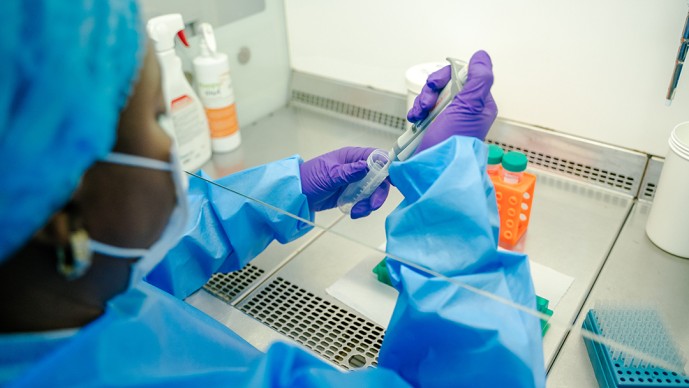
Innovations in Low-Cost and Simplified Pathogen Sequencing Workflows
Gates Foundation (Grand Challenges)
- Location
- Uganda (open globally, LMIC-led applications encouraged)
- Deadline
- 29 September 2026
Grand Challenges award (Tier 1 up to $300,000, Tier 2 up to $600,000, Tier 3 up to $800,000; roughly 15 awards anticipated) for research institutes, nonprofits and academic institutions developing low-cost pathogen-sequencing workflows for public health use in LMICs.
This Grand Challenges initiative from the Gates Foundation, with Temasek Foundation, funds innovations that radically cut the cost and complexity of pathogen genomic sequencing for public health use in low- and middle-income countries.
## About this grant The challenge seeks proposals that push sample-to-sequence costs down to roughly $1-10 per sample while keeping results useful for public health decision-making. Rather than new hardware, it wants innovations in methodology and workflow, such as simplified, modular protocols that run on already-deployed platforms like Illumina, Oxford Nanopore, and MGI/BGI. In-scope applications include viral pathogens (polio, measles, arboviruses, rotavirus, viral hemorrhagic fevers, mpox, and others), malaria drug and diagnostic resistance markers, tuberculosis drug-resistance testing and whole-genome sequencing, and bacterial or microbial antimicrobial resistance and transmission tracking.
## Who can apply - Research institutes, nonprofits, for-profit companies, international organizations, government agencies, and academic institutions - Projects and consortia led by applicants based in low- and middle-income countries (LMICs) are specifically encouraged - Individuals, and organizations classified as individuals for U.S. tax purposes, are not eligible - Applicants must comply with the Gates Foundation's global access requirements - Organizations under UN sanctions, or that derive revenue from controversial weapons or tobacco production, are excluded
## What it covers - Tier 1 (early-stage feasibility and prototyping): up to $300,000 over up to 24 months - Tier 2 (mid-stage workflow optimization with preliminary evidence): up to $600,000 over up to 24 months - Tier 3 (advanced concepts validated in LMIC settings): up to $800,000 over up to 36 months - Approximately 15 awards are expected across all three tiers
## How to apply - Review the RFP, rules and guidelines, application instructions, budget template, and FAQ published on the challenge page - An optional information webinar (recorded for later viewing) is offered ahead of the deadline - Submit a proposal through the Gates Foundation's online application portal - Proposals must include an 18-month plan and proof-of-concept data generated within the first 12 months - Incremental modifications, bulk-procurement approaches, non-sequencing assays, and purely theoretical concepts are explicitly out of scope
## Key dates - Applications open: August 18, 2026 - Optional webinar: September 1, 2026 - Deadline: September 29, 2026, 11:30 AM PDT
No fees are ever required to apply for this grant. Contact the Gates Foundation Grand Challenges team directly with questions.
Eligibility
Benefits & what's on offer
What to submit
Key dates
How to apply
See application link.
Related opportunities

UNICEF Internship Programme
UNICEF
JSI Internship Program
John Snow, Inc. (JSI)

UVRI Undergraduate Internship Programme
Uganda Virus Research Institute (UVRI)
IDI Internship Programme
Infectious Diseases Institute (IDI), Makerere University
MIHS / Mildmay Internship & Placement Programme
Mildmay Institute of Health Sciences (MIHS) / Mildmay Uganda
MU-JHU Care Ltd Internship Programme
Makerere University-Johns Hopkins University (MU-JHU) Care Ltd
This listing is provided for information only. Rate My Musawo does not guarantee its accuracy and is not involved in the recruitment or application process.